A historic hilltop inn — and a cradle of Sheffield football.
High on Myrtle Road in Heeley stands The Ball Inn: a three-storey stone inn on ground with a genuine place in the story of the game — home to The Wednesday in the earliest years of English football, in the city where the modern game itself took shape.
The Ball Inn, Myrtle Road, Heeley
The Setting
More than a local landmark — a stone inn on the brow of the hill.
The Ball Inn sits at Heeley Top, the oldest part of Heeley — gathered around the meeting of Myrtle Road and Heeley Green, on the steepest ground in the district. The name reaches back to Heah Leah, a "high woodland clearing" recorded as far back as 1343.
Myrtle Road rises sharply through the neighbourhood, giving the inn a rare sense of height and open aspect so close to the city centre — a handsome three-storey, stone-fronted building on the brow of the hill, ringed by allotments, gardens and open ground.
Council planners have described it as a "historic attractive building" worth preserving: an anchor of local character at the top of the road, and the namesake of the ground that sits beside it.
The Outlook
An elevated position, above the city.
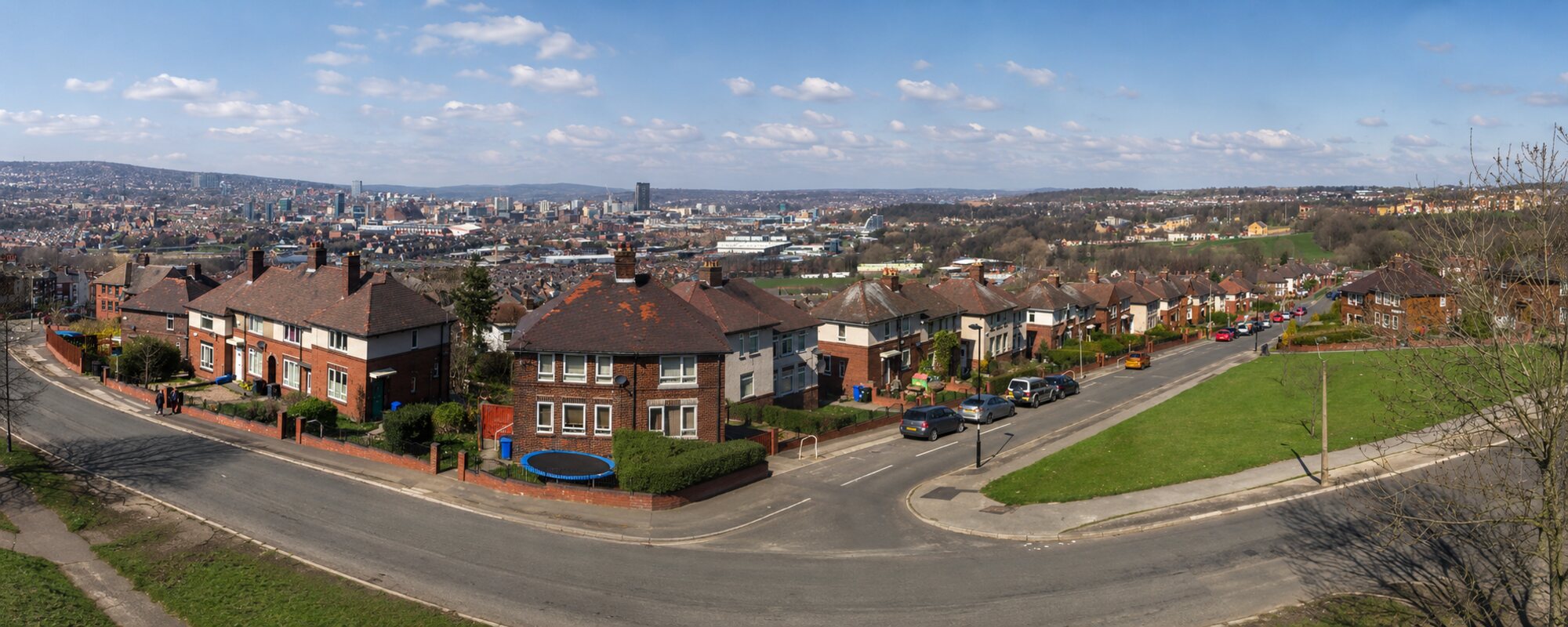
Few sites in Sheffield offer an outlook like this. From the brow of the hill the whole city opens out below — the skyline, the rooftops falling away down the slope, and the green hills of the wider valley beyond, the city and its landscape laid out as if in the palm of your hand.
The Football Story
The Ball Inn ground and the birthplace of football.
To understand the Ball Inn ground, it helps to know that Sheffield is where much of modern football was invented. Sheffield F.C., formed in the city in 1857, is recognised by FIFA as the oldest football club in the world, and the "Sheffield Rules" its members drew up from 1858 introduced ideas the game now takes for granted — corner kicks, free kicks, throw-ins and the crossbar among them. Just up the road, Hallam F.C., founded in 1860, still plays at Sandygate, widely regarded as the oldest football ground on earth. Long before league tables and grandstands, this was the crucible in which the sport found its shape.
It was into that founding culture that The Wednesday arrived. The club began in 1867 as the football offshoot of the Wednesday Cricket Club — a sporting society established back in 1820 and named for the half-day its members took off work each week. In football's earliest years there were no permanent stadiums, no professional players and no national competition; clubs played on rented fields and recreation grounds, with little more than a marked pitch, rough fencing and spectators standing at the touchline.
Between 1870 and 1877, The Wednesday made their home at Myrtle Road. Because the road climbs such a steep hill, football historians have long identified the flatter land beside the old Ball Inn as the most likely site of the pitch — the plot that became known as the Ball Inn Recreation Ground. Their final match here, in 1877, drew a large crowd for a hard-fought goalless draw with local rivals Heeley, before the club moved on: first to Sheaf House, then Olive Grove, and eventually to Owlerton, where, as Sheffield Wednesday, they have played at Hillsborough ever since.
The Ball Inn, Myrtle Road — the inn that gave the recreation ground its name
1857
Sheffield F.C. formed — recognised by FIFA as the world's oldest football club
1870–77
The Wednesday's home years at Myrtle Road / the Ball Inn ground
Two clubs
A rare tangible link to both Sheffield Wednesday and Sheffield United
The ground also carries an unusual cross-city footnote. Decades later, from the late 1950s, the same land was taken on by Sheffield United — the city's other great club, formed at Bramall Lane in 1889 — as a training base, held on a thirty-year lease from the brewery. Few plots of land anywhere can claim a tangible connection to both halves of the Steel City derby: the club that grew up on the hill, and the club that later trained on it.
Few early football locations offer this combination of history and place. The Ball Inn ground is tied to the formative years of one of England's oldest clubs, in the very city where the modern game took shape — a reminder of an era before grand stadiums and mass crowds, when football was still rooted in local streets, open ground and the community gathering places, like the inn itself, that gave their names to the pitches beside them.
The Place Today
The hilltop, today.
The hillside that once drew match-day crowds to the inn is now a settled residential quarter — Victorian terraces, allotments and parkland, with the city spread out below. Everyday life sits a short walk away, and the map shows what surrounds the site now.
The view from the hillside — Sheffield city centre from HeeleyParkland on the doorstep — Heeley's terraces from the green
On the doorstep — within a few minutes' walk
Supermarket & grocery · post office & ATM · local shops · pubs & takeaways · bus stop — all within roughly 300 yards of the site, with allotments, a park and playground directly adjoining.
The Ball Inn — the siteDining & retailCity & transportEveryday servicesGreen space
Today the site is offered as a rare development opportunity — with the clear aim of keeping its history intact. The historic inn is to be retained and sympathetically converted, with two fully worked schemes already drawn for the land alongside it — 14 or 19 apartments — and scope for an alternative vision, subject to planning. Sheffield's planners have described the building as a "historic attractive building" worth preserving: a landmark with a long story, ready for its next chapter.